Monday, August 28, 2023

Authors and Mental Illness


This was originally published as "Writers and Mental Illness" in June 2020.

This isn't a very fun subject to discuss, but it's an important one. In my twenties, I was diagnosed with a "Major Depressive Disorder with Anxiety." It has over the years impeded my productivity, which is why I posted this original post -- after having not posted anything for months.

It's so hard explaining depression to people, and that's because depression is a confusing and frustrating condition. It makes no sense. It leaves no outward physical signs. It's all internal. And often I don't know what's going to trigger me until I actually get triggered. All I can do is try to be more careful next time.

I'm also starting to believe everyone's depression is different. It's a shapeshifter. A trickster. Depressives may share some common symptoms such as the negative thinking and feelings of hopelessness, but from what I've experienced we each have a little extra something-something. 

When my depression flares up, it's often accompanied by tension headaches -- I've compared it to having storm clouds in my head. That tension will run all the way down my neck and into my shoulders and back. I'd go as far as to call it physical damage left behind from battling my negative thoughts (aka my demons). That's why depressives get so tired and listless. We've been spending hours and hours fighting with our minds, trying to get them under control again.

Mental illness has been getting more attention these days, which is great. But there are still so many people out there convinced that it's a choice and not a condition. Believe me it's not! I don't choose to fall into such a deep pit of despair where I'm wondering if life is worth living. Who in the hell would actually choose that?

I had some not so great care in the beginning. Most of the "experts" I saw tried to convince me that after a few rounds of medication and a handful of therapy sessions I'd be okay. It wasn't until, later on, I realized that is not the case. This is a condition I'm going to live with for the rest of my life, and I need to learn how to manage it.

I'm not knocking medication. It does serve a purpose. It's the foundation that supports the rest of my treatment. I've heard people knock therapy, saying therapists don't "do anything." Yes, they do. Their job is to get you thinking about your own mind, get you to ask yourself important questions, and help you draw important conclusions. We're not fixing a car. We're talking about the human mind. It's a little more complex than even a combustion engine.

Therapy has helped me greatly. I was lucky to meet a particular therapist who was an expert in EMDR (Eye Movement Desensitization and Reprocessing).  I made the most growth working with him. He was the first therapist to realize I also suffered from Complex PTSD (the results of a not very happy childhood). 

EMDR basically helps you rewire your brain. After a lifetime of negative and destructive thought patterns, paths literally get carved into your brain. You have no choice but to go down them. You've known nothing else. EMDR has helped me pave over those old paths and helped me forge healthier new ones. 

On top of that, I make sure to get plenty of exercise, eat right, get enough sleep, and maintain that precious work-life balance.

As far as how my depression relates to my creativity ...

There is the romanticized notion of the Tortured Artist, and why not? Many great artists, painters such Vincent Van Gogh and Salvador Dali, and authors such as Ernest Hemingway and Slyvia Plath, have all dealt with some form of mental illness.

In the case of Bipolars, they may be more productive during periods of Mania. There is no conclusive evidence that being mentally ill makes your creative, but there are cases that support the idea that mental illness can aid in creativity. However, it is generally agreed that mental illness does not have to be present for creativity to exist. I've also come across evidence that creative people are more prone to mental illness. Biology is also a factor.

I don't feel qualified to discuss this medically in depth. I can only speak from personal experience. 

I remember one time while I was in a writers' group, I brought up my depression, and a member of group asked if I could "use it" in my writing. The answer is an emphatic no. 

Depression gets in the way of my writing. It gets in the way of EVERYTHING. It often leaves me with no motivation to do anything. In fact, my depression will trigger my imagination and send me spiraling into all sorts of doomsday/worst case scenario thinking. 

Lately though, I've wondered if my depression has influenced my writing on some level. After all, all those dark feelings and thoughts need to be expressed somehow. 

Maybe depression is the flip side of my creativity. When writing, I am pushing my mind to its limits. Maybe the depression is the result of going too far sometimes? It's the price I pay for my creativity.

On the other hand, my creativity -- my stories -- have ended long bouts of depression too. It wasn't easy. I really had to force myself. It was like walking through hell to get to heaven. One of these trips resulted in the completion of my book, Illumina

Writing, creating new worlds and characters, fills me with hope. The process, in and of itself, brings me a level of peace and joy nothing else does. At the risk of sounding crazy, I'd go as far as to say that writing is a spiritual experience for me.

So, for anyone out there who is experiencing depression, mania, or anxiety, do not hold it in, ignore it, or think you can simply distract yourself from it, and it will go away. No, it will not go away on its own, although it may seem like it at times. Remember, it's a shapeshifter. A trickster. 

Above all, do not be ashamed of it. There are people out there who will try to invalidate what you're experiencing, saying you're "being oversensitive" or "making a big deal out of nothing." They'll tell you to "just get over it" or "lighten up." Like I said before, they think depression is a choice and not a condition. 

Don't pay any attention to these people. Your thoughts and your feelings are meaningful and valid, despite what others might tell you. Seek professional help and hold on to the people in your life who will truly support you in this process. There is no quick cure. No magic pill. It is ongoing. It can be frustrating and challenging at times, but don’t give up, hang in there. I assure you it is worth it.

Thursday, August 3, 2023

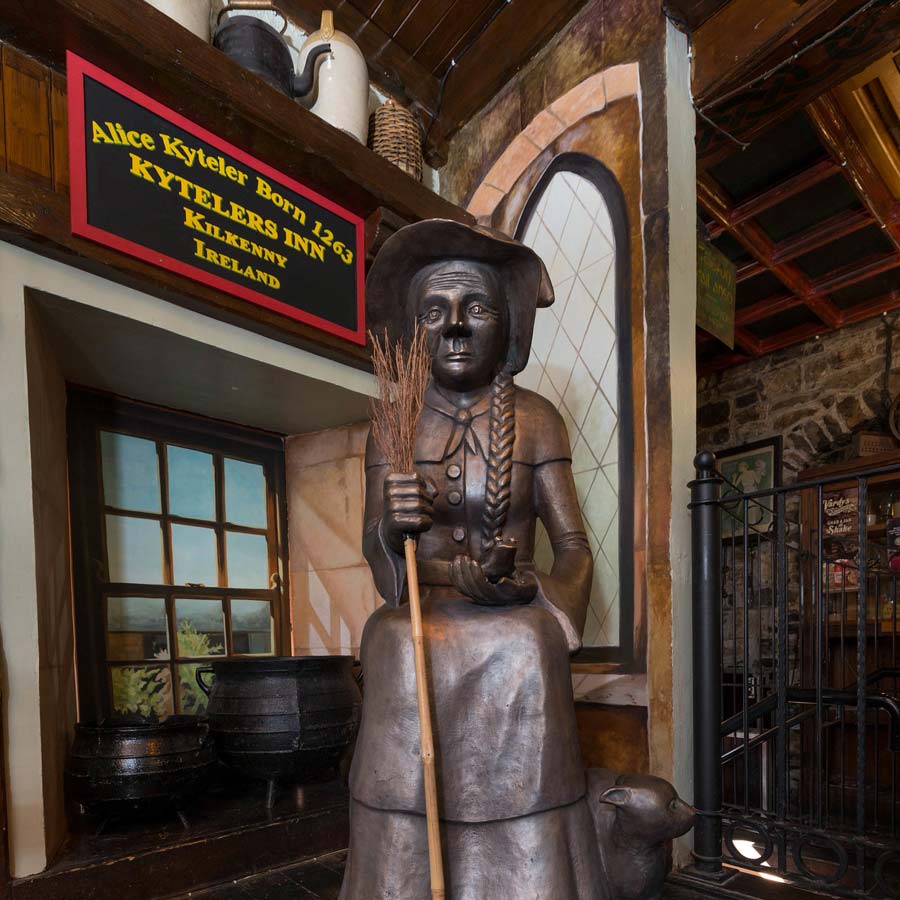
Alice Kyteler


Kytelers Inn | Pubs in Kilkenny, Kilkenny Pubs, Going out in Kilkenny  ,Kilkenny Restaurants, Live Music Kilkenny, Traditional Irish Music, Trad  Music, Night Clubs, Pubs of Ireland, Dame Alice Le Kyteler, Kilkenny

.

My first night in Ireland was spent in Kilkenny City. After a few drinks and a great bowl of seafood chowder, I booked a place on the ghost tour of the city. It was very fun, and our guide was very friendly and knowledgeable. One of the stops we made was to Kyteler's Inn, which had been owned by Alice Kyteler, the first woman to ever be accused of witchcraft in Ireland. I was already somewhat familiar with her story. I learned some additional details for our guide.

Alice was born in 1263. She was said to be very attractive and sophisticated. In 1280, she married her first husband -- In 1302, she married her second husband -- in 1309, her third -- and in 1324, her fourth. Each husband died from "illness," except her third one. He was said to have died during a "drunken spree." Each of Alice's husbands were very rich and very successful, and their fortunes went to Alice after they died. 

Early on, people were already accusing Alice of witchcraft -- that was pretty common for independent and financially successful women back then. It was her fourth husband, who brought formal charges against her shortly before he died. Suddenly, witnesses came out of nowhere claiming to have seen Alice and her associates making sacrifices to the Devil and that her large black dog was actually a shapeshifting demon.

Unfortunately for her prosecutor, Richard Ledrede, the bishop of Ossory, Alice had some very influential friends. In fact, she even got Ledrede arrested. He was released by John Darcy, the Lord Chief Justice. However, by then, Alice had fled Ireland and disappeared into history. Sadly, one of her servants was made a scapegoat for her "crimes" and was flogged and burned at the stake.

Our guide shared a theory about the deaths of Alice Kyteler's husbands. Three out of four of them, the ones who took ill before they passed, displayed symptoms associated with arsenic poisoning -- emaciation, fingernails falling off, and hair turning gray and falling out. 

Apparently, arsenic poisoning was not common in that era so medical experts were not able to give a proper diagnosis. Therefore, it was deemed to be the results of witchcraft. So instead of a witch, Alice may have been a "black widow," marrying rich men, killing them, and inheriting their wealth. 

Aside from her story, Alice left behind her inn -- Kyteler's Inn. It was established in 1324. Originally, it was her home, but she expanded it into an inn, where she was said to entertain rich and influential men who showered her with expensive gifts.

I didn't get a chance to visit the inn, but it sounds like an awesome place. Customers are treated to old school charm and 21st Century amenities, live music, and amazing food and drinks. They can even join in comparative whiskey and gin tastings and learn how to make perfect Irish coffee.

Sigh. Maybe next time.

I left a link below for anyone who wants to learn more about Kyteler's Inn. Enjoy!

Kyteler's Inn

Tuesday, July 11, 2023

The Blarney Witch


This month, I thought I'd start creating some entries that have to do with some of the mystical locations in Ireland. Some I've actually had the privilege of visiting. Others? Someday.

NOTE: The pictures included in this post were ones that I took myself.

During my trip to Ireland, I made sure to visit Blarney Castle in County Cork. This is the location of the Blarney Stone, and as legend has it anyone who kisses the Blarney Stone is suddenly blessed with the great eloquence ( aka 'Blarney'). For over 200 years, people have visited this site and kissed that blessed stone. From normal people all the way to entertainers such as Sir Mick Jagger and James Nesbitt to politicians like Sir Winstone Churchill and Ronald Reagan. I did not kiss the Blarney Stone while I was there. I've been told many times that I'm already brimming with Blarney. Any more Blarney, and I just might burst. 

BLARNEY CASTLE


I spent most of my time at Blarney Castle, walking the foot paths, enjoying some of the other magical spots on the castle grounds. Long before the castle had been built, that part of Ireland was known to be home to witches, druids, and fairies. Those who have built upon this particular piece of land, over the years, made sure to honor its magical history. I wonder if they feared the "consequences" of what might have happened if they didn't.

Some spots the grounds you can visit include the Druid's Cave, the Druid's Circle, and the Sacrificial Altar. One of my favorite sites was the Witches Stone. It's a boulder with a witch's profile hidden within its shape. According to some sources, the Blarney Witch (as she be came to known) terrorized that area long before the castle had been constructed. At some point, she was tricked into the stone and remained trapped there during the daylight. While trapped in the stone, the witch is supposed to bestow wishes to those who are able to walk up and down backwards the Wishing Steps, while thinking only about their wishes and nothing else. I tried the Wishing Steps, which are quite steep and slippery after a bit of rain. All I could think of the whole time was not falling. 

THE WITCHES STONE

THE WISHING STEPS

Near the Witches Stone is a small cave with a kitchen and a chimney hidden inside. This is the Witches Kitchen, and it is supposed to be where the Blarney Witch flees to every night when she is able to escape her stone prison. There, she continues to craft spells and brews. Some say if you arrive around dawn, you can see the dying embers of her fire. 

    THE WITCHES KITCHEN

No one knows who built the first castle on that land, but the MacCarthy family built what would become known as Blarney Castle in 1446. There's a story about the lord of the manor, at that time, Cormac Laidir MacCarthy who was involved in a lawsuit. He prayed to the Celtic goddess Cliodhna (who just happens to be a character in my book Death's Fair Maiden) for help. She told him to kiss the first stone he found in the field on his way to the court. Cormac did exactly that, and later discovered he was able to argue his case with newfound eloquence and won it. 

In another version the story, the stone was already part of the castle. Originally, it had been part of a site used for druid rituals, hence it's great power. In this version, it was the Blarney Witch herself who told Cormac about its power after she'd saved him from drowning.

I love that about Ireland. Its mythology, legends, and folklore are just as important as its history -- and they are often intertwined with it. 

Monday, June 5, 2023

The Fomorians


The Greek gods battled the Titans. The Norse gods, the Aesir, had mortal enemies in the Jotunn. Not to be left out, the Irish gods, the Tuatha Dé Danann, had the Fomorians, demonic giants whom they battled for possession of Ireland.

The origin of the Fomorians is open to interpretation. If you break down their name -- Fo means below or beneath -- Mo means sea. This could mean they came either from the sea or some form of underworld. Or maybe both. After all, they are connected to Domnu, a primordial goddess commonly known as "The Queen of the Dark Places." Who's to say those dark places exist both underground and in the ocean depths?

The Fomorians are mentioned early on in the Book of Invasions, which chronicles the different tribes that called Ireland home, before and after the Tuatha Dé Danann. In the beginning, the Fomorians weren't depicted as being demonic giants. Instead, they came off more like pirates from some unknown land. 

As a writer, I took some liberty with the Fomorians' origins for my Colin Caulfield and the Irish Gods series. I portray the Fomorians as originally being human pirates who worshipped Domnu. They tried to take over Ireland multiple times. After constantly failing, their egos broken, they looked to their goddess for help and begged Domnu to give them the power to defeat their enemies and take over Ireland. Domnu listened and turned them into the monsters they are today.

Fomorians appear grotesque and misshapen. Some even have animal heads or missing or multiple body parts. I shouldn't say all of them. Some Fomorians are born human-looking and even considered "darkly beautiful." It reminds me of how the Frost Giants on Norse mythology were said to have incredibly beautiful daughters -- for no discernible reason whatsoever. 

There is one Fomorian I want to focus on in particular, because he is set to make his presence felt in the second installment of Colin Caulfield and the Irish Gods -- The Fifth Cycle: Lost Gods.

His name is Balor.

He is the greatest leader the Fomorians ever had and is described as a grotesque giant with one bulbous eye in the middle of his head. That eye remains closed most of the time. For good reason. If he opens it, anyone he stares at dies a tortuous, horrifying death. 

In addition to being a heavy-hitter for the bad guys, Balor and Colin share a very personal connection. It starts with a prophecy, many centuries ago, where Balor learns he will be killed by his grandson. To prevent this from happening, he locks his only -- and very gorgeous daughter, Ethniu, in a tower so no one can reach her. Or least that was his plan.

Cian, one of the Tuatha Dé Danann, learns about Ethniu and the prophecy. He's angry about Balor stealing a prize cow, and out of revenge uses some magic to sneak into Ethniu's tower, seduces her, and impregnates her with triplet boys. 

This prophecy is similar to one involving the Greek Titan, Cronus. In it, he hears how one of his children will grow up and kill him. To keep this from happening, he killed his children -- specifically he ate them. However, at the last second, his wife swapped a stone in place of the youngest child, the boy who would become Zeus, king of the Greek gods. She hid him, and Zeus was raised in secret by his grandmother, Gaia, until he became full-grown, killed his father, and took his place. Before Cronus died though, Zeus made him regurgitate his siblings, who were somehow still alive.

When Balor learns about Ethniu's pregnancy, he makes a similar choice as Cronus. Instead of eating his triplet grandsons though, Balor chucks them into the ocean. Only one of them survives. He is rescued by Mannanán, the god of the sea, and whisked away to the Otherworld where he's raised in secret. This boy grows up to become Lugh, the god of light, the greatest warrior, and master of all crafts. 

Not to mention Colin's father.  

Like Zeus, Lugh grows up to face off with Balor during an epic battle between the Tuatha Dé Danann and the Fomorians. He fulfills the prophecy by killing Balor. In some versions, he uses a magical weapon known as the Invincible Spear. In some others, he uses a sling -- which makes this story comparable to David and Goliath.

At this point in time, The Fifth Cycle: Lost Gods is still a work-in-progress. All I will say is that Balor is set to make his grand appearance -- or reappearance near the end of the book, in what I hope will be a surprising manner. He will continue to make his presence felt in later installments of the series.

Until then, if I plan on releasing The Fifth Cycle: Lost Gods in time for St. Paddy's Day 2024 (I hope, I hope, I hope), I best get back to writing.


Thursday, April 27, 2023

The Werewolves of Ossory


        I am crazy about werewolves! Wolves too for that matter. The wolf is my totem. It is such a complex and misunderstood animal. They’ve gotten a bad rep over the years and have been portrayed as brutal killers who prey on humans. In reality, they’re not. 
    When I wrote Welcome to Harmony, I wanted the werewolves featured in that book to be as misunderstood as wolves. I also wanted them to have some of the characteristics of wolves such as they are family oriented, mate for life, take excellent care of their young, and actually protect the balance within their ecosystem.
I’ve covered werewolves in the past, in some of my first blog posts. This month though, I thought I’d focus on werewolves in Ireland – since I’ve begun introducing Irish myth and folklore into my books.
A long time ago, wolves were a fundamental part of Ireland’s landscape. However, in the sixteenth centuries, mass wolf exterminations began. From what I’ve been able to tell, this was because wolves were found feasting on the dead following some epic battles. In the seventeenth century, the most extensive anti-wolf legislation and exterminations began, thanks to one Oliver Cromwell, the King of England’s appointed persecutor – I mean, “protector” of Ireland. 
Wolf exterminations continued long after Cromwell’s reign, and as of the 21st century, other than some wolves living in the Dublin Zoo and some on a special wilderness preserve, wolves are extinct in Ireland.
In ancient times, the kingdom of Ossory was the home of werewolves in Ireland. There is no more Ossory. What was once Ossory is now part of County Kilkenny and part of County Laois. There was a legend of a warrior named Laignech Fáelad, who was known to go “wolfing” which meant that he would take on “wolf shape.” Other members of his family would join him, and they would raid local livestock herds as well as hunt in the forest. 
Fáelad and his family were mercenaries and in high demand. They never accepted gold for their services though. Instead, it was said, they took their payment in newborn baby flesh. Yikes! This could be due to their connection to Crom Cruach, one of the ancient deities of Ireland, whose followers practiced human sacrifice. 
Fáelad and his family gained their shapeshifting ability by being cursed back in the 5th century. Saint Natalis was trying to convert the Irish to Christianity. Fáelad and his family were having none of it and howled like wolves while Saint Natalis tried to preach. He became furious and cursed them, turning them into actual wolves. Apparently, at some point, Fáelad and his family must have learned to shift back and forth between human and wolf.
Not all of Fáelad’s family were werewolves though. He was said to be the brother of Feradach mac Duach, the king of Ossory, and the ancestor of subsequent kings who ruled Ossory until the invasion of the Normans in the 12th century.
In that time period, one of the most famous stories about the Werewolves of Ossory surfaced. Gerard of Wales, a priest and historian, wrote a book titled Topographia Hibernica (Geography of Ireland). In it, he told the story – he claimed it was true – of an unnamed priest who encountered a talking wolf in the woods. The wolf begged him not to be afraid. He promised he wouldn’t hurt the priest and then went on to tell him his story.
He and a woman were natives of Ossory. They don’t mention whether or not they were descended from Fáelad or not, but they do reference the curse laid on their family by Saint Natalis (In a later version of the story, he was replaced by Saint Patrick). The talking wolf said that every seven years, a man and a woman in their family were forced to abandon their human form and live like wolves. If they survived, they were allowed to return to human form, and a new man and woman were chosen to become wolves for seven years. 
The talking wolf said that the woman, his mate, had become fatally ill. The talking wolf asked the priest to perform the last rites over his dying mate. In order to convince the priest he would not be committing blasphemy, he pulled back the female’s wolf skin to show she was human underneath. The priest delivered the last rites as he promised, and in return the wolf shared prophecies about the future of Ireland and its English invaders. I couldn’t find any details about what those prophecies contained though.
This is all good stuff and fuel for future stories. The great thing about being a writer and working with material like this is I get to change what I want and make it my own. Since stories about the Werewolves of Ossory didn’t become widespread until the 12th Century, I honestly feel that Christian authorities might have demonized them the same way they did witches. Also, Gerard of Wales' story about the priest and werewolves seems to promote the idea of Christianity over pagan belief. 
        But like I mentioned already, if you have read Welcome to Harmony yet, you know I love dealing with misunderstood werewolves.

Thursday, March 23, 2023

The Changeling


    This month I shall focus on one of the most popular figures in Irish myth and folklore next to the leprechaun and the banshee. I'm talking about the changeling. In most stories, it is a fairy infant that is sickly and dying. In others, it's an elderly fairy that is approaching a similar fate.

    Fairies have an attraction for all things beautiful, especially humans -- babies, children, and adults. Some sources say that fairies aren't able to reproduce at the same rate as humans, and if they find a desirable child they will swap it out with a fairy that doesn't have long to live. A bit of illusion casting aka a glamour spell and no one knows the difference.

    You can imagine, long ago, when these stories were first told, that infant mortality was pretty high. Children were stillborn or simply got sick and died. It would probably bring some consolation to these distraught families to believe their child was still alive and enjoying that life to the fullest in a magical kingdom. 

    Abductees weren't limited to children and babies either. Human men and women were said to be taken away by fairies too. These were exceptionally beautiful men and women who often had some sort of special talent. Human-fairy offspring were supposed to be pretty common. These hybrids were able to reproduce much easier than pure-blood fairies.

    In my research, I did come across a very famous and very "true" story about an Irish woman who was supposedly kidnapped by fairies. In 1895, in County Tipperary, Ireland, 26 year old Bridget Cleary was murdered by her husband who had claimed she wasn't Bridget at all. Instead, she was a changeling who'd replaced his stolen wife.

    Bridget's husband, Michael, worked as a cooper, constructing barrels and other items, while she worked as a dressmaker's assistant. Bridget also took care of local family members, often delivering food and essentials to them. Her husband did not like this very much, especially since on one of her routes she had to pass by a known faerie circle (or faerie mound). These were ancient stone structures, usually circular forts that had long been abandoned by humans and were said to have been taken over by fairies. Legend had it, if you got too close to a faerie circle or a faerie mound, you might get kidnapped -- especially if you were a beautiful and talented young woman like Bridget. Their replacements were supposed to be noticeable, because they displayed strange behavior at times, fell sick, or had some slight difference in their appearance that was only discernible by someone very close to them. 

    One day, Bridget returned from one of these deliveries and fell very ill. She could not stay warm and complained of a raging pain in her head. This went on for days. Bridget's family came to help. They brought in the local doctor (and a priest to deliver last rites, just in case). The doctor diagnosed Bridget as suffering from “nervous excitement and slight bronchitis” and prescribed some medicine for her.  However, the medicine did not work. Michael, Bridget's family, and their neighbors began to suspect there was more going on.

    Michael believed that the Bridget that had returned to him was two inches taller now and much "finer looks" than his wife. He came to believe Bridget had been kidnapped by fairies and replaced with a changeling. 

    Back in those days, there were people actually known as "faerie doctors" who were called in to handle such cases as this. Michael and the rest of Bridget's family brought in one to examine Bridget. He performed some sort of examination and declared that, instead of being a changeling, Bridget was possessed by a faerie. He force fed her an "herbal cure" that would drive it out of her. Witnesses described Bridget as acting "wild and deranged," but she eventually settled down. She then appeared to have returned to normal. That was until she declared she had a powerful craving for fresh milk. Apparently, fairies loved fresh milk.

    Michael was then convinced she was, in fact, a changeling, and killed her. He buried her in a shallow grave a quarter mile from their home then camped out by the local faerie circle, where he believed Bridget had been abducted. He waited for three nights, thinking she would be returned. 

    But, well, I think we can guess what happened.

    Michael was arrested for Bridget's murder. The story made international news, and scholars and medical experts are still trying to understand what actually happened. The power of belief is strong. We want answers to things we don't understand. When Bridget fell ill, Michael originally called a doctor, which is something someone who believed in the supernatural wouldn't do -- at least at first. When medicine didn't work, maybe Michael was desperate enough to believe that fairies were real. After all, the belief was still widespread especially in the rural areas of Ireland, and like many others Michael was most likely indoctrinated with stories their antics all his life. 

  Mental illness might have been an issue too. Michael might have suffered a delusional condition somehow triggered by how distraught he'd become when Bridget took ill. 

    Or maybe it was a cover-up for an intentional or accidental death. 

   Bridget was a woman who defied social expectations for that time period. She was married but very independent. She didn't seem to want to be a homemaker. She had her own job and didn't bend to her husband's wishes. 

    Perhaps Michael got fed up with this. Maybe he was even teased and ridiculed by other men over not being able to "keep his wife in line." He and the other men in the community decided to punish her, using "faerie magic" as an excuse. In the end, Michael and his friends were only charged with manslaughter instead of murder. Maybe the story they told saved them from the gallows.

    It's still a mystery. And possibly the basis for a future story.         


Friday, February 10, 2023

The Merrow


           This month I’m focusing on the Irish version of the mermaid – the merrow – and she is a far cry from Princess Ariel. In some stories, merrows resemble the sirens of Greek myths in that they sing a song that lures sailors to their death. In other stories, they are more like the selkie, another creature from Irish myth and folklore that I covered in a previous post. 

           The merrow is a gorgeous woman from the waist up and fish-like from the waist down. Her lower body is covered in greenish-tinted scales. She also has green hair which she grooms with a comb. She has a delicate webbing between her fingers which is supposed to resemble the skin between an egg and its shell. It’s interesting that her lower body is described as “fishlike.” In some sources, and popular culture, she has a fish tail. In other stories, she has two legs with feet like fins – which could resemble a fish tail, I suppose, if they were together.

            In most stories, merrows are gentle and affectionate and have been known to marry human men. There is a case of such a marriage taking place in Bantry, in southwestern Ireland, that resulted in hybrid children who were covered in scales and had webbed fingers. Merrows were also supposed to be in possession of a garment that allowed them to take human-form and live on land, much like their selkie cousins. In some stories, it’s a cap – probably like a diving cap. In others, they literally remove their skin to take human form then put it back on when they’re ready to return to the sea.
            Like the selkie, if a human man takes the merrow’s cap (or skin), they can control the merrow. After years of such captivity though, instincts give out, and the merrow will return to the sea. Although , without their cap or skin, I can’t help but think this might be a form of suicide. In some stories, the merrow will take their human lover with them. Perhaps, this is a punishment. The man would most likely drown without some sort of magical intervention.
            Then there are stories where the opposite is true. The merrow will actually kidnap a human sailor and force him to live with her underwater – with the help of a magical enchantment. Unfortunately, in these stories, the merrow is possessive and will go into a jealous rage if their human suitor tries to flee. They might even eat them.
             The merrow appears to have been taken very seriously by the Irish. Many human men were supposed to have been seduced by them over the centuries. It’s believed that men and women with the last names of O’Flaherty and O’Sullivan in County Kerry and County Clare are supposed to be descended from these marriages. I’m assuming the webbed hands and scaly skin was rather subtle or perhaps disappeared over the generations.
             The female merrow or merrow-maiden definitely preferred human males to their male counterparts, the merrow-men, who were supposed to be quite hideous. Descriptions vary, but they sound like something out of an H.P. Lovecraft story. They aren’t very fond of human men, jealousy no doubt, and have been known to abduct sailors and force them to live underwater, through magical means, as slaves.

             I’ve got a couple ideas on how I want to use merrows in future stories. In fact, while researching them, a whole slew of new possibilities came to mind. I will keep you updated on what develops next.


Percy Jackson and Me

  I stumbled upon Percy Jackson and the Olympians: The Lightning Thief when it first came out. It was a total happy accident, because I abso...